Location: Brisbane, QLD

Professional Project
Project Type B2B Consulting
Hardware Status v2.0
Organisation Cerebra
Completion Date 2023

Problem Outline

MK1 None Functional.

Cerebra is a charity that develops innovative products to help children with brain conditions participate in everyday activities and sport. The charity had previously developed a Mk1 prototype of a sensory tag rugby system; however, the original electronics were not functional.

The brief was to redesign the electronics and develop a robust wearable tag rugby system. The belt needed to provide clear multi-sensory feedback through high-visibility LEDs, an audible buzzer and haptic vibration, allowing players with different sensory needs to immediately recognise when they had been tagged.

The system also required low-power RF communication with a pitch-side receiver, which announces the colour of the tagged team to assist referees, officials and spectators.

Key Technical Responsibilities

  • Sensory tag product with blue tag attached.

    Schematics: Designed full-system MCU, BMS, and tag sensing in Altium.

  • RF Design: Integrated 433MHz module with Pi matching network.
  • Power Logic: Gated peripherals to eliminate idle current draw.
  • Sensory UI: Implemented LED, buzzer, and haptic feedback.
  • Sensor R&D: Invented low-cost, low-power tag-colour sensor.
  • Bring-Up: Executed board bring-up, debugging, and RF range testing.
  • Thermal Analysis: Profiled peak operational thermal behaviour.
  • DFM / Spatial: Fixed 3rd-party CAD interference errors in Altium.
  • Client Lead: De-risked technical decisions and managed delivery.

Design Simplification & Risk Reduction

Review of the original prototype identified several areas where the electronics could be significantly simplified. One example was the replacement of a complex NFC-based tag detection system with a single analogue Hall-effect sensor. Using the magnets already present in the mechanical tag attachment, the system could identify up to four team colours from magnetic field polarity and magnitude using a single MCU input.

Power consumption was another key consideration. A digital Hall sensor and hardware load switch were used to isolate high-current peripherals—including the LEDs, buzzer and haptic motor—when they were not required. This reduced standby current and helped maximise battery life from the compact rechargeable cell.

For pitch-side telemetry, an off-the-shelf 433 MHz RF module was integrated with a custom matching network and flexible antenna options. Addressable RGB LEDs were also selected to simplify PCB routing and firmware control.

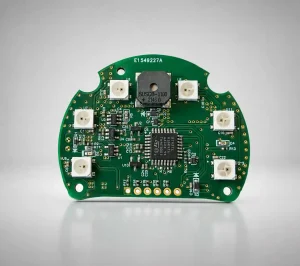
The final electronics had to fit within a compact curved enclosure with tight Z-height constraints. A densely populated double-sided PCB was developed with consideration for charging, thermal performance and mechanical clearances. A dedicated 3D spatial review in Altium identified screw-boss and pogo-pin clearance issues before manufacture, reducing the risk of mechanical rework during assembly.

Bring-Up & Testing

Laboratory bring-up verified the power rails, charging circuitry and core hardware functions before the prototypes were released to the software team for firmware integration.

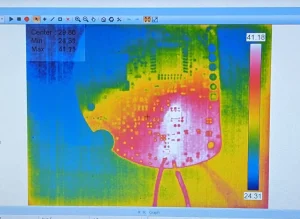
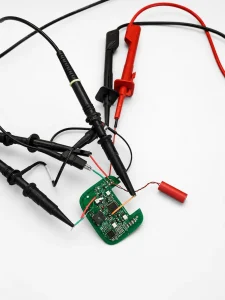
Thermal testing was also carried out to assess the charging circuit and PCB heat dissipation. The charging IC reached a measured peak temperature of approximately 42°C under the tested conditions.

Formal EMC compliance testing was outside the scope of this development phase.

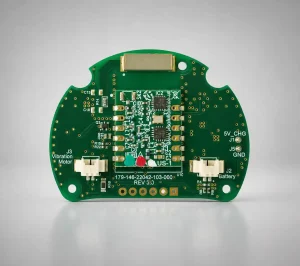
PCB top view.
PCB bottom view.
Thermal testing.

Field Testing

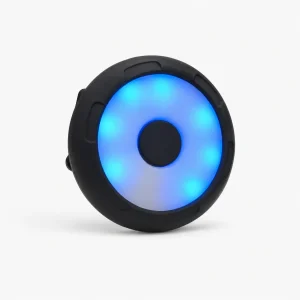
Sensory rugby tag in final enclosure and protective case flashing blue.

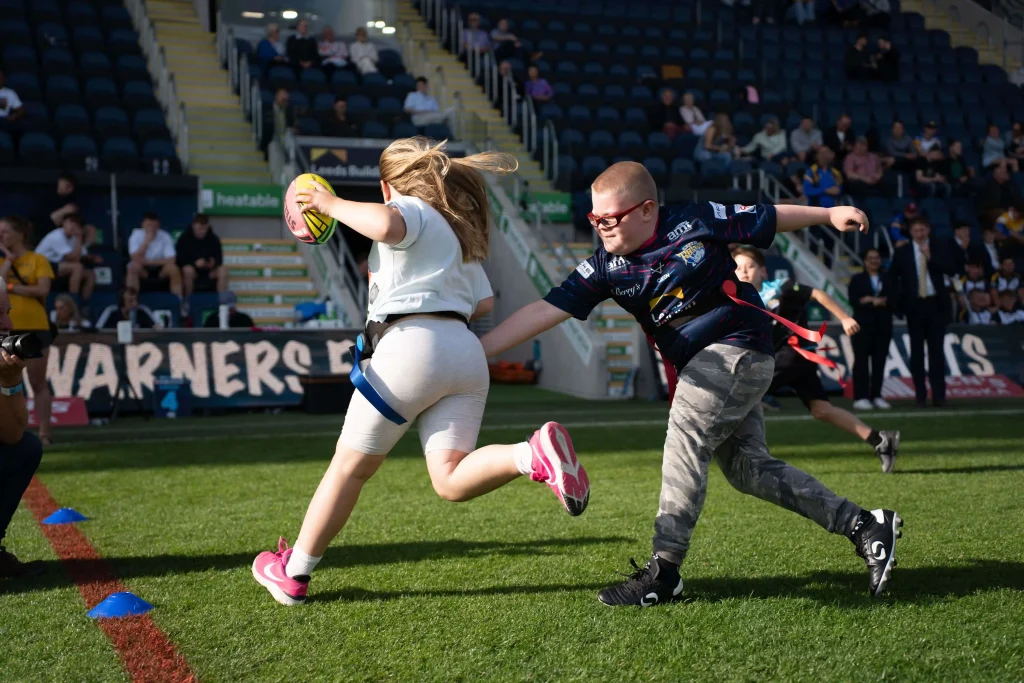
Following bench validation, the sensory belts were deployed in field trials with the Leeds Rhinos Foundation and Saracens.

The trials provided an opportunity to evaluate the system under real playing conditions, including the mechanical durability of the wearable enclosure, visibility of the LED feedback, operation of the haptic and audible alerts, RF communication and battery endurance.

The hardware performed successfully throughout the sessions and the battery capacity was sufficient for the duration of the trials.

Client feedback following the sessions was positive:

“Positive testing with the Leeds Rhinos Foundation and Saracens. The participants really loved the concept, and we’ve learned a lot from the sessions.”

User Trials at AMT Headingley Rugby Stadium on the 14th June 2025.

Conclusion & Engineering Retrospective

The MVP successfully demonstrated the required functionality and provided a proven platform for further development. If progressing towards higher-volume production, several areas would be worth optimising:

  • Standardise Component Pitch: Move the charging pogo pins to a standard 1.27 mm pitch, allowing the use of readily available docking hardware rather than bespoke components.
  • RF Range Optimisation: The enclosure reduced RF range compared with open-air testing. Although performance remained sufficient for the intended application, further antenna tuning and VNA testing could improve link margin and robustness.
  • Reduce Standby Current: With the peripheral loads already isolated, MCU sleep current becomes a significant contributor to standby power consumption. A future revision could evaluate alternative MCUs with improved low-power performance.
  • Reduce RF BOM Cost: For higher production volumes, the pre-certified RF module could be replaced with a discrete RF implementation to reduce unit cost, subject to the additional RF development and compliance work required.
Scroll to Top