Location: Brisbane, QLD

Wi-Fi Controlled Reflow Oven

Maker Project
Project Type Independent
Hardware Status Work In Progress
Collaborators
Completion Date

Problem Outline

Small reflow ovens are widely used for prototype PCB assembly, but many DIY conversions rely on either basic onboard controls or external electronics and displays that add wiring and clutter to the workbench.

The aim of this project was to develop a cleaner, more flexible system: a Wi-Fi-enabled reflow oven that could be configured and controlled directly from a desktop browser.

The system needed to provide closed-loop temperature control, real-time thermal monitoring and configurable reflow profiles while keeping the hardware compact enough to integrate cleanly with the oven.

A further objective was to develop a reusable temperature-measurement platform rather than an oven-specific collection of breakout boards, resulting in the design of a custom Raspberry Pi HAT for precision thermocouple measurement.
Small reflow ovens are widely used for prototype PCB assembly, but many DIY conversions rely on either basic onboard controls or external electronics and displays that add wiring and clutter to the workbench.

The aim of this project was to develop a cleaner, more flexible system: a Wi-Fi-enabled reflow oven that could be configured and controlled directly from a desktop browser.

The system needed to provide closed-loop temperature control, real-time thermal monitoring and configurable reflow profiles while keeping the hardware compact enough to integrate cleanly with the oven.

A further objective was to develop a reusable temperature-measurement platform rather than an oven-specific collection of breakout boards, resulting in the design of a custom Raspberry Pi HAT for precision thermocouple measurement.
Design & Architecture Phase

The system is built around a Raspberry Pi running the supervisory control and browser-based interface, combined with a custom PCB for thermocouple measurement and a zero-cross solid-state relay controlling the oven heating elements.

A K-type thermocouple provides the primary process-temperature feedback. Temperature data is acquired by the custom PCB and passed to the Raspberry Pi, where a PID control loop determines the required heater output.

Node-RED provides the local web interface and process-control environment, allowing the oven to be operated wirelessly from any device on the same network without requiring a dedicated display or control panel.

The resulting architecture is:

Reflow Oven → K-Type Thermocouple → Custom Measurement PCB → Raspberry Pi → Node-RED Web Interface

Heater power is controlled separately through the zero-cross SSR under command from the Raspberry Pi.


Hardware

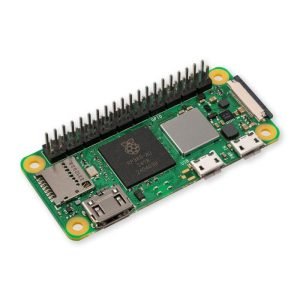
RPI Zero 2WH Single Board Computer.

Raspberry Pi Controller:

A Raspberry Pi Zero 2 W was selected as the permanent controller, providing sufficient processing capability for the control application together with integrated Wi-Fi in a compact form factor.

Development was initially carried out using a Raspberry Pi 4, allowing the software and interface to be developed without resource constraints before deploying the application to the smaller Zero 2 W.

Most routine operation is performed through the browser-based interface, with SSH retained for system configuration and maintenance.


Custom Thermocouple HAT:

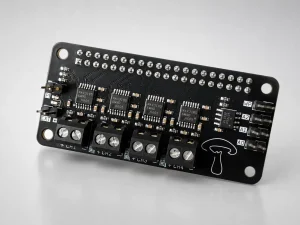
Custom PI Zero HAT for 4 channel precision temperature measurement.

Rather than assemble the temperature-measurement system from multiple breakout boards, a dedicated Raspberry Pi HAT was designed in KiCad.

The board provides four K-type thermocouple measurement channels, allowing several temperature points within the oven or across a PCB to be monitored using a single compact interface. The channels are read sequentially over the SPI interface rather than sampled simultaneously, which is sufficient for the relatively slow thermal dynamics of the reflow process.

Each channel uses a MAX31856 thermocouple interface, providing cold-junction compensation, thermocouple linearisation and mains-frequency noise rejection.

Although the oven control loop requires only a single primary feedback channel, the additional inputs are useful for comparing temperatures at different locations and make the board reusable for future thermal-measurement applications.

The board can be powered directly from the Raspberry Pi or through an external supply connection and was designed around the standard Pi HAT form factor for straightforward integration.

Provision was also included for onboard configuration storage, allowing future revisions to support automatic identification and configuration of the measurement hardware.

Web Interface

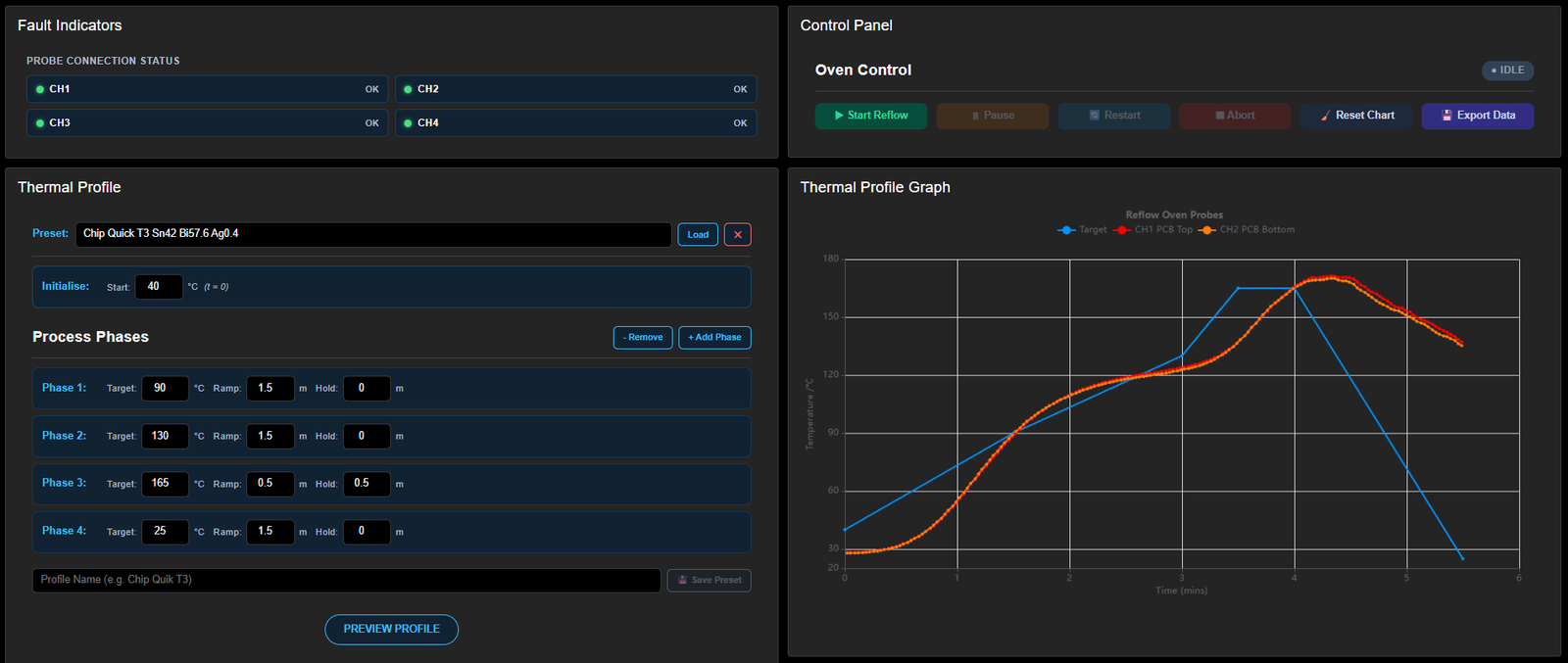
A browser-based dashboard was developed in Node-RED to provide a clean control interface without adding buttons or displays to the oven itself.

The interface provides:

  • Configurable Reflow Profiles: Reflow stages and temperature targets can be entered manually and saved for reuse with different solder pastes.
  • Profile Preview: The target thermal profile can be visualised before starting a cycle.
  • Live Temperature Monitoring: Thermocouple measurements are plotted throughout the reflow process.
  • Fault Detection: Open or shorted thermocouple channels are identified and reported through the interface.
  • Process Control: A state-machine-based sequence manages the reflow cycle with Start, Pause, Reset and Abort controls.
  • Data Export: Completed thermal-cycle data can be exported as a CSV file for subsequent analysis.

This provides full control and monitoring from a desktop or mobile browser while leaving the oven itself mechanically unmodified apart from the required sensing and heater-control connections.

Graphical user web interface for the reflow oven.


PID Control & Thermal Testing

The PID controller was tuned experimentally over a series of thermal cycles to achieve stable profile tracking while limiting overshoot.

The final test configuration used:

  • Kp: 3.2
  • Ki: 0.005
  • Kd: 12.0

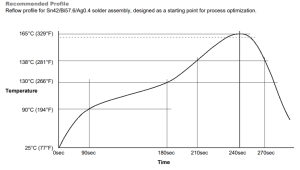
Performance was evaluated against the recommended reflow profile for Chip Quik Sn42/Bi57.6/Ag0.4 solder.

Chip Quik T3 (Sn42 Bi57.6 Ag0.4) Thermal Profile.

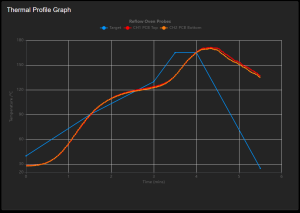
During testing, the measured oven temperature followed the target profile closely through the preheat and thermal-soak regions. The rapid rise into the reflow peak was intentionally tuned more conservatively because the thermal inertia of the oven means aggressive control at this stage can produce excessive overshoot.

The resulting profile reaches the peak temperature slightly later than the idealised target but limits peak overshoot to approximately 5°C, providing a more controlled thermal cycle.

Additional thermocouples were positioned at different locations on the test PCB to assess temperature distribution. Sequential measurements from the upper and lower locations tracked closely throughout the cycle, indicating good thermal uniformity across the board and no significant localised hot or cold regions under the tested conditions.

Passive cooling remains slower than the idealised reference profile, as expected from a converted toaster oven without active cooling.

Target vs. measured reflow profile during PID-controlled thermal testing.

Conclusion & Engineering Retrospective

The project has successfully demonstrated the core technical concept: wireless control, configurable thermal profiles, closed-loop PID regulation, multi-channel temperature measurement and automated process logging can all be implemented using a compact Raspberry Pi-based architecture.

One of the more useful outcomes has been the custom thermocouple HAT. Although developed specifically for the reflow oven, its four-channel architecture provides a reusable platform for other thermal measurement and development work.

The thermal testing also reinforced the importance of tuning the control system around the physical characteristics of the oven rather than attempting to reproduce an idealised profile at any cost. The oven’s thermal inertia places practical limits on heating and passive cooling rates, and accepting a slightly slower approach to peak temperature produced a controlled result with limited overshoot.

The project is not yet mechanically complete. The Raspberry Pi, thermocouple HAT and associated control electronics still need to be integrated into a suitable enclosure to create a neat, robust system for regular workshop use.

The next stage will therefore focus on packaging the electronics and completing the physical integration, followed by reflow testing with populated PCBs and inspection of the resulting solder joints. These tests will provide the final practical validation of both the thermal profile and the completed system.

Scroll to Top