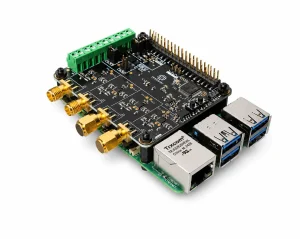
Before modifying the analogue design, baseline noise performance of the existing Revision 1 hardware was characterised to provide an objective reference against which future revisions could be evaluated.
A Python-based test workflow was developed to automate data acquisition and analysis. For the documented noise test, the analogue input was connected to analogue ground and 12,000 ADC measurements were captured and processed to determine RMS noise, peak-to-peak noise, effective resolution and noise-free resolution.
The resulting dataset established a measured baseline of approximately 38.3 µV RMS noise, with a noise-free resolution of approximately 16 bits under the documented test conditions.
Automating the measurement and analysis process provided a repeatable method that can be reused when Revision 2 hardware becomes available, allowing the impact of the cost-down and circuit changes to be assessed directly against the original product.
Product Documentation:
Alongside the hardware development, a new technical datasheet was produced to better document the capabilities and architecture of the product.
The document covers the ADC architecture, Raspberry Pi interface, modular stacking arrangement, configurable analogue filtering, electrical and mechanical specifications, measured noise performance and typical application scenarios.
Producing the documentation alongside the engineering review also provided an opportunity to consolidate technical information about the existing product and establish a clearer reference for future customers and subsequent hardware revisions.
Current Status:
The Revision 2 schematic changes have been completed and the updated PCB is currently progressing through layout.
The next hardware revision incorporates the cost-reduction and circuit-simplification work described above. Once manufactured, the revised hardware can be characterised using the same automated noise-performance test methodology established on the Revision 1 boards, allowing direct comparison of the two designs.