Context: Inductosense develops patented ultrasonic wall-thickness monitoring technology for high-resolution, non-destructive asset integrity measurement. While the technology had already been commercialised for land-based applications, subsea deployment was limited to a single-channel, 300m-rated prototype previously validated in offshore field trials.
The Challenge: Scale the early proof-of-concept into a commercial-grade, 32-channel subsea monitoring system capable of operation at depths of 3,000m. The system required dual-redundant electronics, integration with both mobile ROV/AUV platforms and permanent subsea installations, and an operational design life exceeding 25 years.
Over more than two years, my involvement covered system architecture, hardware bring-up, ultrasonic signal optimisation, EMC remediation, thermal and mechanical integration, manufacturing readiness and environmental qualification.
Key Technical Responsibilities
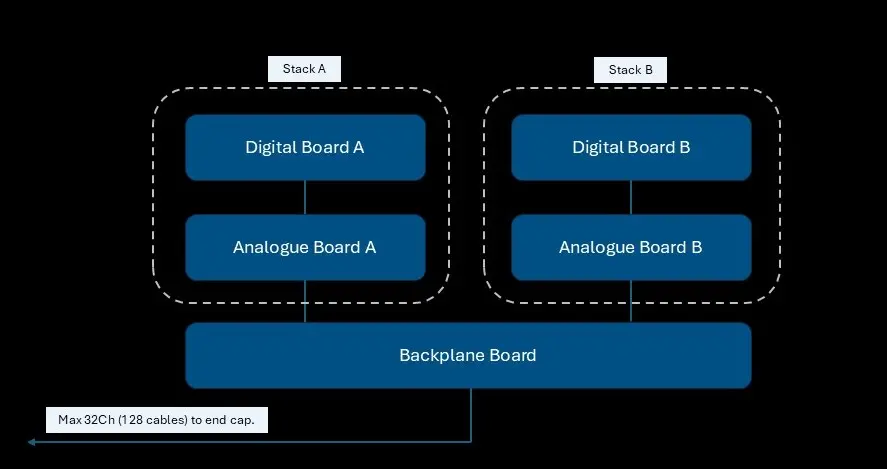
System Architecture & Redundancy: Developed the hardware architecture around two independent electronics stacks, incorporating watchdog supervision and recovery mechanisms to maintain operation following primary hardware or firmware faults.
Communications & Integration: Designed the physical communications layer for topside and subsea integration, supporting 10/100BASE-T Ethernet, RS-485/422 and CAN.
Hardware Bring-Up & Signal Optimisation: Led board bring-up and performance characterisation, diagnosing ultrasonic excitation degradation through the multiplexer chain and iteratively improving the hardware alongside firmware development.
EMC & Qualification: Conducted pre-compliance EMC testing, isolated an EN55011 Class B conducted-emissions issue to the DC supply switching circuitry, and implemented low-cost suppression before final qualification.
Reliability & API 17F: Supported environmental, hyperbaric, thermal and EMC qualification and gathered Failure In Time data to assess the design against its >25-year operational-life target.
Mechanical, Thermal & Manufacturing: Supported card-frame and heatsink integration through thermal profiling and gap-pad selection, while also defining component staking, conformal coating, assembly and environmental test procedures.
Design & Architecture Phase
System Architecture & Redundancy
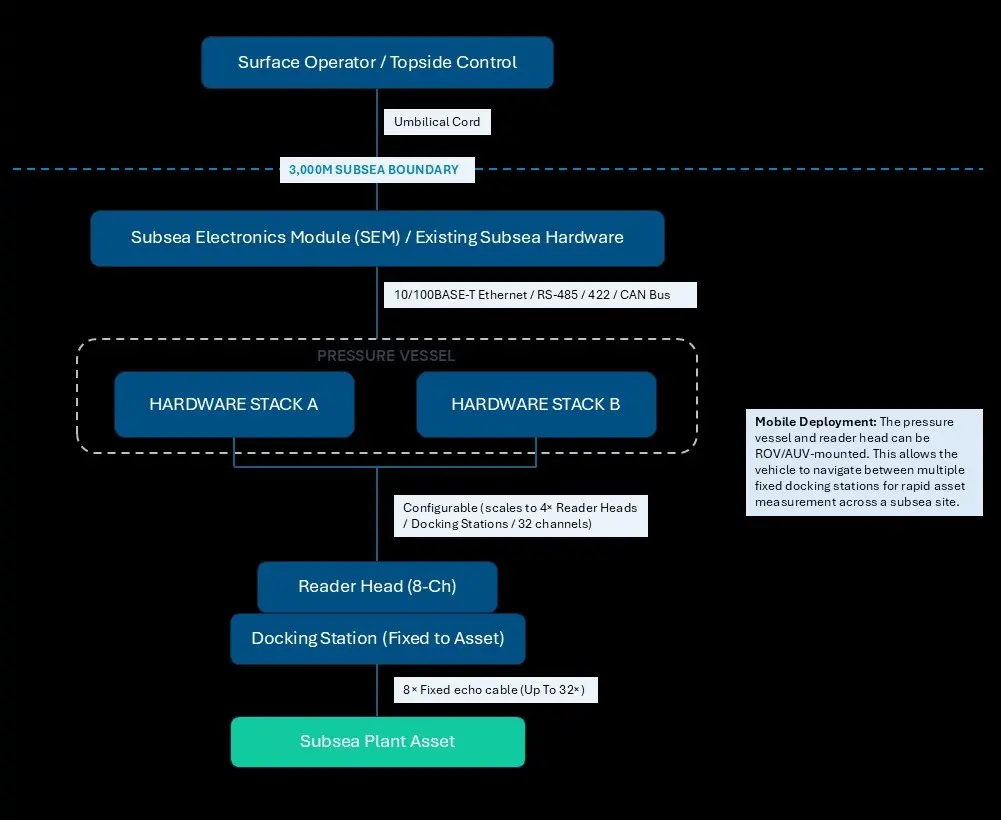
The subsea pressure vessel was designed around two fully independent electronics stacks, providing hardware redundancy for long-term operation in a deep-water environment. Each stack incorporated its own analogue and digital electronics, with watchdog supervision and a controlled boot/recovery mechanism allowing the system to recover from operational crashes or failed firmware updates.
A secure backup firmware image provided an additional recovery path if an update could not be completed successfully.
Scaling & Physical Packaging
Scaling the technology from a single-channel prototype to a 32-channel commercial system introduced significant packaging challenges. Each ultrasonic channel required separate transmit and receive twisted pairs, resulting in 128 individual signal conductors at full capacity.
Cable routing therefore became a major mechanical design constraint alongside the need to survive hyperbaric pressure, thermal cycling and vibration qualification.
The physical dimensions of the pressure vessel were ultimately driven largely by the requirement for COTS subsea connectors rated for operation at 3,000m.
Standardisation & System Integration
With connector requirements defining much of the available internal volume, the electronics were standardised around the 100 × 160mm Eurocard format, providing a repeatable mechanical platform and compatibility with existing Subsea Electronics Modules.
The overall architecture incorporated a dedicated reader head and docking station and supported integration across ROV, AUV and permanent seabed installations. Communications included RS-485/422, CAN and 10/100BASE-T Ethernet.
Deepstar 3,000m subsea system block diagram.Electronics stack A & B block diagram.
Bring-Up & Implementation Phase
Hardware bring-up was performed progressively at board level, beginning with manufacturing inspection and controlled first power-up of the analogue and digital assemblies.
Because firmware and hardware development were progressing in parallel, dedicated prototype interfaces were used to exercise the analogue signal path before the final digital-board firmware was available. A secondary STM32-based breakout board controlled the output multiplexers, while Python scripts were used to select individual measurement channels during early testing.
This allowed the ultrasonic excitation and receive paths to be characterised directly on an oscilloscope and provided a repeatable method for validating each channel.
Bring-up identified several issues before integration, including an intermittency problem caused by insufficient voltage-regulator dropout margin. A replacement component was identified and implemented before system-level testing.
Thermal profiling of both boards was also carried out during development, providing the data required to guide custom heatsink design and thermal-interface material selection.
During signal characterisation, degradation of the ultrasonic excitation waveform was traced through the output multiplexer chain. Hardware changes were developed and tested alongside firmware optimisation until system performance exceeded the existing commercial baseline.
Testing & Qualification Stage
Qualification formed a major part of the development programme, with testing covering pressure, electromagnetic compatibility, thermal performance and mechanical vibration. My involvement ranged from complete ownership of the hyperbaric and EMC programmes through to development of procedures, test hardware and supporting fixtures for the thermal and vibration campaigns.
Hyperbaric Qualification
I was responsible for the hyperbaric qualification activity from preparation through to execution.
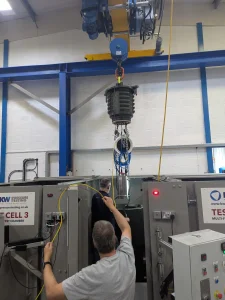
The complete electronics assembly was prepared for pressure testing in a 1000-bar-rated hyperbaric chamber, including configuration of the test hardware, electrical interfaces and monitoring equipment. The system was then exercised under pressure to verify operation of the electronics and associated subsea interfaces in the intended deep-water environment.
This work required careful preparation of the complete test article, verification of electrical functionality before and after testing, and coordination of the equipment required to monitor system behaviour throughout the pressure cycle.
The testing provided confidence that the electronics and mechanical integration could operate reliably under the extreme hydrostatic pressures associated with deep-water deployment.
Reliability analysis also incorporated component Failure In Time data to assess the electronics against the project’s targeted operational life of more than 25 years.
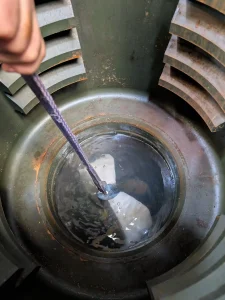
Docking station test fit in the hyperbaric test chamber.The subsea system being lowered into 1000 Bar hyperbaric test chamber.
EMC Testing & Remediation
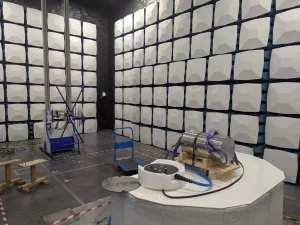
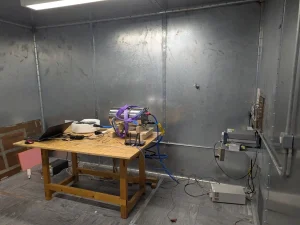
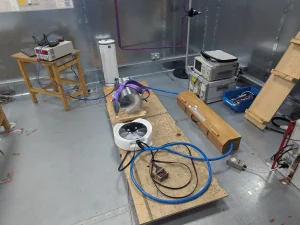
Testing covered conducted emissions, radiated emissions and immunity, with the aim of identifying issues early enough to resolve them before final qualification. During pre-compliance testing, conducted emissions exceeding the EN55011 Class B limit were identified on the DC power input.
Using near-field probing, oscilloscope measurements and spectrum analysis, I traced the dominant emissions to switching activity within the power-supply circuitry. The issue was then mitigated through a targeted, low-cost MLCC-based suppression modification before the system progressed to final qualification.
The completed hardware subsequently underwent the wider EMC programme, including radiated emissions, conducted emissions and immunity testing.
This was particularly valuable because the work went beyond simply attending a compliance test — it involved finding the source of the failure, understanding the coupling mechanism, implementing a practical hardware change and verifying the improvement.
Radiated Emissions.Conducted Emissions.Immunity.
Thermal Screening
A key part of the qualification programme was full-system thermal screening, used to identify potential early-life failures before the equipment entered service.
This work was not focused on individual component temperature measurement, but on exercising the assembled system under controlled thermal stress to expose faults associated with infant mortality. The screening regime included 48 hours at the design high temperature, 48 hours at the design low temperature, and 10 rapid temperature cycles between the specified limits.
Testing of this kind is valuable for revealing latent issues such as marginal solder joints, assembly defects or other weaknesses that may not appear during normal bench testing but can emerge early in a product’s operational life.
I helped define the screening approach and produced the supporting test procedure for this part of the programme before emigrating to Australia.
Vibration Test Preparation
Mechanical vibration qualification required a representative mounting arrangement capable of securing the complete electronics assembly to the shaker table while reproducing the intended mechanical interfaces of the deployed system.
I supported the design of a custom aluminium vibration fixture, working through the mechanical requirements for mounting and retaining the electronics during testing. I also assembled the electronics and associated test hardware in preparation for the qualification campaign.
The fixture provided a rigid and repeatable interface between the electronics assembly and shaker table, allowing the system to be exercised under controlled vibration loads without introducing unintended movement from the test setup itself.
While I was not present for the final vibration test campaign, I contributed to the fixture design and completed the hardware preparation required for testing.
Outcome:
Together, the pressure, EMC, thermal and vibration programmes formed a substantial part of the transition from prototype hardware to a production-ready subsea platform. My role extended beyond electronics design into test planning, fault investigation, qualification hardware, procedures and practical execution of the verification programme.
Project Outcome
Over more than 24 months, the project progressed from an early single-channel subsea prototype into a commercial-grade, 32-channel dual-redundant ultrasonic monitoring platform designed for 3,000m deployment.
My involvement spanned the complete hardware development cycle — from system architecture and electronics integration through board bring-up, signal optimisation, EMC troubleshooting, thermal design, manufacturing preparation and environmental qualification.
The completed system represents the most substantial electronics development programme I have worked on to date and brought together high-reliability hardware, subsea mechanical integration, ultrasonic instrumentation and long-term qualification within a single product platform.